Key Takeaways
Choosing the right hardscape materials for Asheville NC homes requires understanding the region’s freeze-thaw cycles, heavy seasonal rainfall, and steep mountain terrain. Natural stone, concrete pavers, gravel, and poured concrete each perform differently under these conditions. Material selection affects long-term maintenance costs, drainage behavior, and how well a project holds up over 10 to 20 years in Western North Carolina’s demanding climate.
- Natural stone such as bluestone, flagstone, and locally quarried granite performs exceptionally well in Asheville’s climate due to its freeze-thaw resistance and regional aesthetic compatibility.
- Concrete pavers offer predictable costs, modular repair options, and good drainage when installed with permeable joints, making them a practical choice for driveways and patios.
- Poured concrete is the most affordable upfront but cracks more readily under freeze-thaw stress without proper reinforcement and control joints spaced every 8 to 10 feet.
- Gravel and crushed stone provide excellent drainage on sloped lots, reduce runoff, and cost 40 to 60 percent less per square foot than mortared stone installations.
- Slope, soil composition, and drainage all determine which material is appropriate for a given site before any installation begins.
- A professional site assessment saves homeowners from costly material failures caused by poor substrate preparation or incompatible material choices for the specific terrain.
Why Hardscape Material Choice Matters on Mountain Properties
Hardscape materials for Asheville NC homes face a specific set of stressors that flatland properties rarely encounter. Asheville sits at roughly 2,134 feet above sea level, and surrounding communities like Biltmore Forest experience an average of 47 inches of rainfall per year combined with 15 to 20 freeze-thaw cycles annually. A patio or walkway material that performs beautifully in Charlotte can fracture, heave, or wash out entirely within three winters in the mountains. Getting the material selection right from the start is not a cosmetic decision. It is a structural and financial one.
Mountain lots in this region commonly feature clay-heavy soils, dramatic elevation changes, and natural water flow paths that shift with every heavy rain event. Any hardscape installation placed without accounting for these site-specific factors risks settling unevenly, retaining water beneath its surface, or becoming a source of erosion rather than a solution to it. This is why the choice between natural stone, concrete pavers, poured concrete, and gravel should be made with full knowledge of how each material behaves under local conditions, not just how each one looks in a catalog photo.
Hutch N Son Landscaping has worked across Asheville’s varied terrain for over 50 years, installing walkways, stone borders, and paver systems on lots ranging from relatively flat residential yards to severely graded hillsides. That accumulated field experience informs every material recommendation the team makes before a single stone is set or a single form is poured. Understanding what works locally, and what fails, is the foundation of every project. For more information on site-specific conditions and drainage challenges, consult resources from the U.S. Environmental Protection Agency regarding stormwater management and soil assessment.
Natural Stone: Performance and Aesthetics on Asheville Terrain
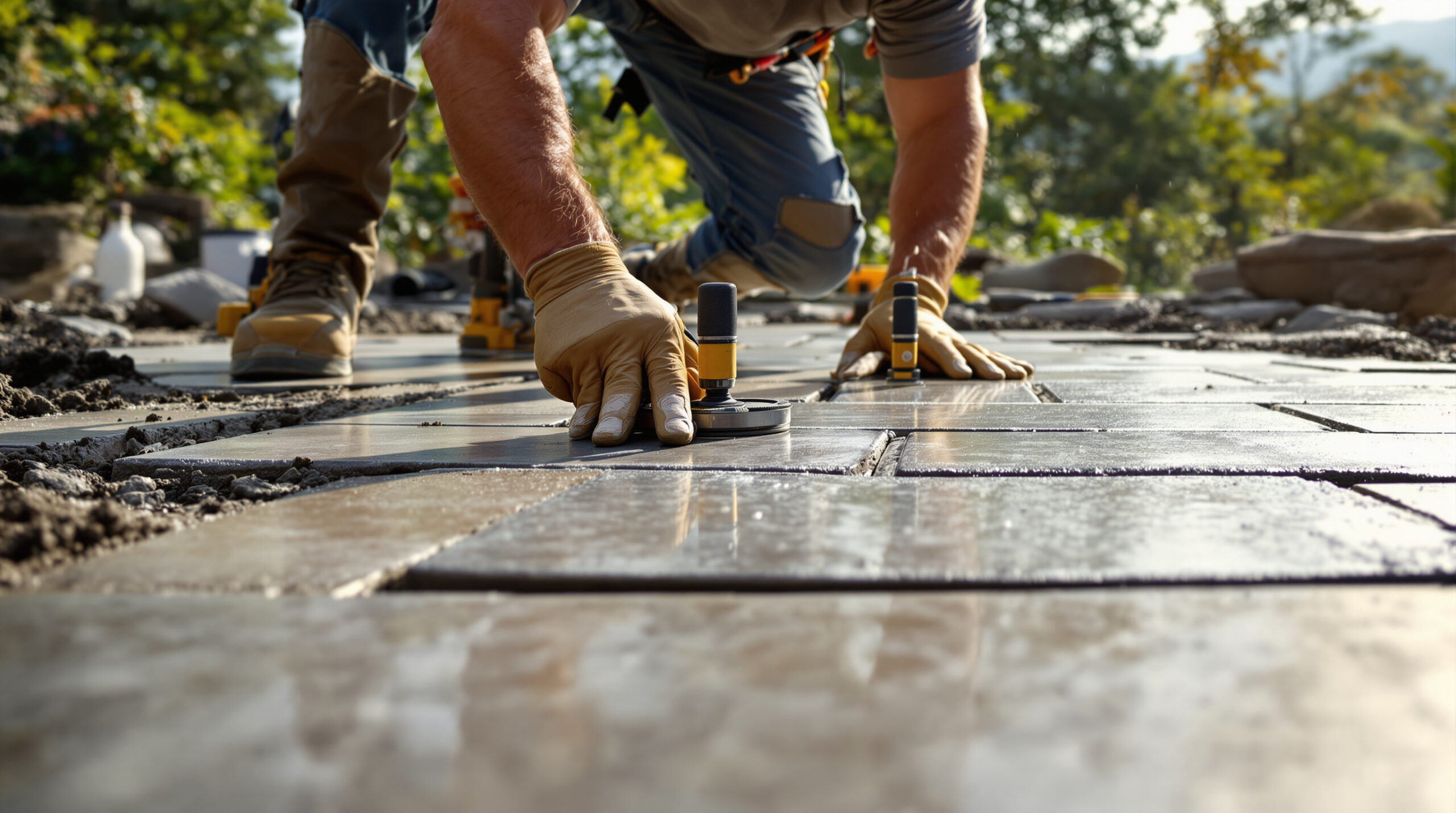
Natural stone is one of the most reliable hardscape materials for Asheville NC homes when properly installed, and it performs particularly well under the region’s freeze-thaw cycles because it expands and contracts at rates that solid poured surfaces cannot match.
Which stone types hold up best in Western North Carolina winters?
Bluestone, fieldstone, and locally quarried granite are the three most commonly specified natural stones for Asheville hardscape projects. Bluestone, which typically costs between $15 and $30 per square foot installed depending on thickness and pattern, offers a consistent surface texture that provides traction even after heavy rain. Locally quarried granite and fieldstone carry cost advantages because transportation distances are shorter, and they carry a visual continuity with the region’s natural geology that imported stone cannot replicate. Slate performs well aesthetically but tends to delaminate after repeated freeze cycles and is generally not recommended for outdoor horizontal surfaces above 2,000 feet elevation. Learn more about natural stone properties and geological composition from Wikipedia’s article on bluestone.
What does a proper natural stone installation involve in terms of base preparation?
A quality natural stone installation in Asheville begins with 6 to 8 inches of compacted gravel base material, typically 57-stone or crusher run, depending on expected load. This base layer allows water to drain away from the underside of the stone rather than pooling and freezing beneath it. Flagstone set in a dry-laid configuration over compacted gravel actually outperforms mortared stone in freeze-thaw environments because individual stones can shift slightly without cracking the entire surface. Mortared applications require a concrete substrate with control joints and are better suited to sheltered areas like covered patios.
How does natural stone affect long-term maintenance costs compared to other materials?
Natural stone surfaces installed correctly require minimal maintenance for 20 to 30 years. Occasional re-sanding of joints in dry-laid applications and periodic sealing of porous varieties like limestone represent the primary ongoing costs. A well-set flagstone walkway that cost $20 per square foot to install in year one may require only $200 to $400 in maintenance over its first decade, compared to poured concrete that may need crack repair within five years at a cost of $300 to $800 per repair cycle depending on severity.
Concrete Pavers: Flexibility and Repairability for Residential Hardscaping
Concrete pavers offer homeowners in the Asheville area a modular system that allows individual units to be removed and replaced without disturbing the surrounding surface, which makes them a practical long-term investment on properties with active tree roots or shifting soils.
What are the real cost ranges for concrete paver installation in this region?
Concrete pavers typically run between $10 and $20 per square foot for materials, with installed costs ranging from $18 to $35 per square foot depending on pattern complexity, base depth requirements, and edge restraint systems. Permeable pavers, which allow water to pass through the joints and into a gravel reservoir below, cost roughly 15 to 25 percent more than standard pavers but significantly reduce surface runoff on Asheville’s sloped lots. Given that the city of Asheville has adopted stormwater regulations that penalize excessive impervious surface coverage, permeable paver systems are increasingly worth the premium. For regulatory guidance on stormwater management, refer to the EPA’s stormwater management resources.
How do concrete pavers handle freeze-thaw cycles compared to a solid slab?
Individual pavers move independently under thermal stress, which means the surface accommodates expansion and contraction without developing the linear cracks that form in poured concrete slabs. A properly installed paver surface over a 6-inch compacted base can withstand 20 or more annual freeze-thaw cycles without significant degradation. The joints between pavers must be filled with polymeric sand, which locks units together while still allowing micro-movement. Standard sand joints wash out in heavy rain events and should not be used on any Asheville installation receiving regular rainfall exposure.
What patterns and configurations work best for sloped driveways and walkways?
On slopes exceeding a 5 percent grade, herringbone patterns provide the highest interlock strength because the 45-degree offset transfers lateral forces more efficiently than running bond or stacked configurations. Paver thickness also matters on driveways: 60mm pavers are standard for pedestrian areas, while 80mm units are specified for driveways expecting vehicle traffic. Edge restraints made of aluminum or heavy-duty plastic must be staked at 12-inch intervals on sloped installations to prevent lateral creep over time.
Poured Concrete: When It Works and When It Fails in Asheville
Poured concrete is the most cost-effective hardscape material upfront, with installation costs typically ranging from $6 to $12 per square foot, but it requires specific design features to perform acceptably in Asheville’s climate rather than becoming a maintenance liability within a few years.
Why does poured concrete crack more frequently at higher elevations?
The physics of concrete cracking in mountain climates come down to water infiltration and thermal cycling. Concrete is inherently porous at a microscopic level. Water enters, freezes at temperatures below 32 degrees Fahrenheit, expands approximately 9 percent by volume, and creates internal pressure that exceeds the tensile strength of standard concrete mixes over repeated cycles. Asheville averages 15 to 20 of these cycles per winter. Using a 4,000 PSI concrete mix rather than the standard 3,000 PSI and incorporating air-entraining admixtures at a rate of 5 to 7 percent reduces this failure rate substantially by creating microscopic voids that buffer ice expansion. For technical guidance on concrete durability in freeze-thaw environments, consult the National Institutes of Health and related construction material research institutions.
What control joint spacing prevents cracking in local conditions?
Control joints should be cut or formed at intervals no greater than 8 to 10 feet in both directions to accommodate inevitable concrete movement without creating visible random cracking. In Asheville’s climate, 6-foot spacing is preferable. Joints must be sealed with a flexible polyurethane or silicone compound that moves with the concrete; rigid caulking fails immediately under thermal stress. A concrete surface installed without proper joint spacing and sealing will begin showing distress within 3 to 5 winters regardless of mix design, making joint planning as important as material selection itself.